The Making Of Elgin Vintage
The Depot:
The day after we got back from that first camping trip, I was at home and I randomly started looking up Elgin Watch stuff. I don’t even know why. I wasn’t researching anything big. It was just curiosity. But that was the day I really discovered Elgin for the first time.
And once I started reading, something in me lit up. It didn’t feel random. It felt like I was supposed to be seeing it.
I got in my truck and drove to where I thought the old factory had been. I didn’t know what I was doing. I just went. And the first thing I found was the historical marker in the parking lot. I stopped, got out, read it… and that alone could’ve been the end of it.
But when I got back in the truck, instead of turning toward home, I turned the other way. No plan. No reason. Just… turned. And that’s when I saw it.
The Depot.
I had never seen it before in my life. I didn’t even know what it was. But the second I saw it, I literally pulled over and just sat there looking at it. It wasn’t like, “Oh cool, a building.” It was more like, “Why does this feel important?”
The Depot gives you a weird feeling the first time. Not a bad one — just heavy. Like it knows something. Like it’s been waiting for someone to pay attention.
It sits there almost like an old neighbor.
Stubborn.
Doesn’t care about change.
Not trying to impress anybody.
And somehow it’s still not silent.
It’s like it wants to say something if you’re willing to hear it.
I walked up to the windows and that’s when everything changed. The displays inside — the watches, the little history blurbs — they pulled me in harder than anything else. They made me want to know more. And without even thinking about it, I followed that trail all the way over to the Elgin History Museum.
Later in the day, when I walked behind The Depot and saw the original factory pillars down the hill… yeah, that hit me. Hard. Seeing those pillars — the only ones left — made the whole thing real. You stand there and you realize you’re standing in the last spot where the factory still speaks.
And here’s the wild part:
When I brought my family there, they felt it too.
They stood with me at the top of that hill, saw the same slice of the river, the casino in the distance, the pillars below, and they understood why it meant something to me.
The Depot became a place we built around — not physically, but mentally. It grounded us. It gave us a direction we didn’t even know we needed. It gave us something solid to center our life around at a time we really needed that.
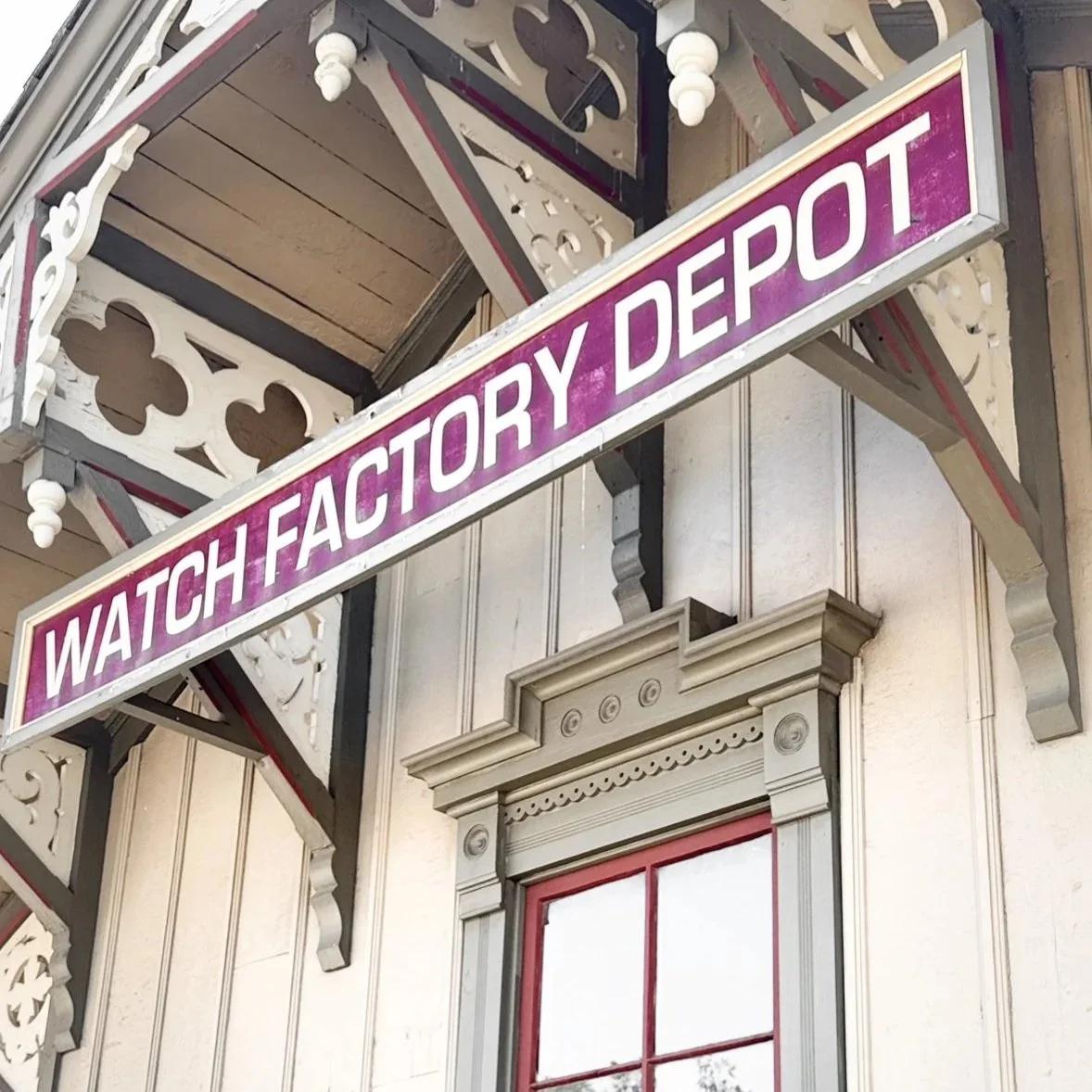
That one moment — pulling over at the Depot — is literally what started everything that came after. The museum. Liz. Bill. John. NAWCC. My collection. My purpose. My direction. All of it.
The Depot was just the first door.
It’s weird how a place can do that.
How something you weren’t even looking for becomes the thing that changes everything.
Sometimes people ask why I care so much about that one building. But the truth is simple:
Because that’s where it all started for me.
Not because I planned it.
Not because I was looking for it.
But because I made one random turn… and the Depot was sitting there waiting.
And honestly?
I’m glad I turned.
I’m glad I stopped.
Because if I didn’t, none of this — literally none of it — would’ve happened.
The Depot didn’t just show me history.
It introduced me to the story I was meant to be part of.
The Depot: Connection
I remember walking up thinking,
“Dude, you literally just learned about this company… what are you doing walking into a museum like you’re ready to talk about anything?”
But I went in anyway.
Inside, I met the volunteers. They were friendly, normal, welcoming — not intimidating at all.
There was a class field trip going on too, so the whole place was buzzing. Kids everywhere, teachers talking, volunteers guiding groups. Seeing it like that made the museum feel alive, like it wasn’t just a quiet place full of old stuff… it was actively teaching people.
I wandered around and eventually found their watch collection on the second floor.
Seeing those Elgin watches behind the glass — the layout, the stories, the movements — it hit me. It shaped the direction of my own collection almost instantly. It gave me ideas. It made me want to learn more. It lit something in me that hadn’t been lit before.
After a bit, I had a short conversation with the Museum Director — nothing major, nothing heavy, but enough to plant a seed in my mind.
Then I left.
Still curious.
Still thinking.
Still pulled right back into the Depot and everything connected to it.
The second time I went to the museum, my family came with me.
And this visit felt totally different.
We walked through the same rooms, looked at the same displays, saw the same watches… and my family finally started to understand why this whole thing was hitting me so hard.
And then something happened that I wasn't expecting. After seeing the watch exhibit and some small talk.
Out of nowhere — completely unprompted — the Museum Director walked straight up to my wife, Karestin.
Not to me.
To her.
And said:
“We think Travis could be a big asset to the Depot’s restoration.”
Hearing that… from someone who didn’t owe me anything, who knew the history better than anyone, who had no reason to say it unless they meant it — that hit deep.
It was the first time I realized this wasn’t all in my head.
I wasn’t imagining the pull.
I wasn’t forcing something that didn’t fit.
People are connected to this history every day…
And they saw something in me.
And that was the moment it started to feel real.
Not a hobby.
Not curiosity.
A calling.
The Depot: Rebirth
After those first two museum visits, something in me flipped. I wasn’t “interested” anymore — I was locked in. I wanted to know everything. I wanted to understand the company, the people, the timeline, the movements… all of it.
That’s when William Briska’s book became my whole world.
I bought it on that first museum trip, not really understanding how important it was going to be. I just saw the author’s name and thought, “Alright, if I’m gonna learn this, I might as well learn it from the guy who wrote the biggest piece of it.”
I didn’t know who he was.
I didn’t know I’d eventually meet him.
I just knew the book felt important.
And from that point on, I lived in that thing.
Every time we went camping, the book came with me.
Every fire we sat around.
Every quiet morning.
Every night laying in the camper.
I’d be flipping pages, underlining things, rereading sections, trying to fit the entire company into my head.
It wasn’t boring.
It wasn’t school.
It was fuel.
The more I read, the deeper I got.
The deeper I got, the more everything started falling into place — the dates, the models, the movements, the factory expansions, the timeline, the culture of the company. It was like learning a language, and suddenly everything at the museum and Depot made more sense.
And the crazy thing is…
This didn’t feel like work.
I’d be grocery shopping and suddenly remembering a movement number.
I’d be pumping gas thinking about a model line.
I’d be scrolling eBay already knowing what I was looking at before the seller even knew.
It got to me fast.
And that’s how the research started.
Watching videos.
Reading old ads.
Digging through old catalogs.
Comparing dials.
Looking for inconsistencies.
Learning reference numbers in my sleep.
Trying to understand what made Elgin so different — and why nobody was talking about it today.
It wasn’t about being a collector.
It wasn’t about hunting rare pieces.
It was about understanding the company enough that I could actually help keep its story alive.
By the time I finished the book, I wasn’t the same person who picked it up.
And what’s wild is…
The second I closed that book, something inside me said:
“Alright. Now it’s time to do something.”
That was the moment I reached out to the Museum Director about the Depot — the moment I decided this wasn’t going to be a quiet hobby.
I wasn’t gonna sit on the sidelines.
I wanted to be involved.
I wanted to learn more.
I wanted to help.
I wanted to protect the story that grabbed me so hard and so fast.
That was the start of the grind — the hours and hours and hours I’ve put into this since May.
And little did I know…
The guy who wrote that book, the one whose words basically rewired my brain around Elgin…
…would be standing inside the Depot with us not long after. But that’s the next chapter.
The Depot: The Meeting They Forgot, and the One That Changed Everything
After I finished reading Elgin Time, I emailed the Museum Director about wanting to help with the Depot. I didn’t try to sound smart or official. I just told her I felt connected to this place and wanted to be part of whatever came next.
She set up a meeting at the Depot.
So we went — me and Karestin.
And man… that day was rough.
We pulled up excited, ready, thinking this was the start of something. But the longer we sat there, the more it became obvious:
Nobody was coming.
No cars.
No calls.
No “running late.”
Nothing.
Just me and Karestin standing at the Depot… waiting for a meeting that wasn’t happening.
I’m not gonna lie — I was frustrated.
My wife saw it.
She saw the anger, the disappointment, the “why am I even doing this?” feeling.
It sucked.
The place that meant so much to me — the place I felt pulled toward — suddenly felt like it didn’t take me seriously.
Or worse… like I didn’t belong.
But Karestin told me to hold on.
Not give up.
Not let that moment ruin everything.
And she was right.
Later that day, the Museum Director emailed, apologized, and rescheduled.
This time she said someone else would be joining us:
“William Briska will be there too.”
I knew the name.
The author.
The book I had been dragging around everywhere.
But knowing his name and actually meeting him are two very different things.
When the day of the rescheduled meeting came, me and Karestin drove back to the Depot.
This time, a car pulled up — the Museum Director, William Briska, and his wife, all riding together.
“There he is. That’s the guy who wrote the book I’ve basically been living in.”
And weirdly enough, I wasn’t nervous.
It felt natural.
Like of course this was happening.
Like the story was just unfolding the way it was supposed to.
We talked right there in front of the Depot — me, Karestin, the Museum Director, William, and his wife.
We talked about the building, the history, what it used to be, what it could be again.
And for the first time, it didn’t feel like I was on the outside looking in.
It felt like I was supposed to be standing there.
Like I belonged in that conversation.
Like I was stepping into the story instead of reading about it.
It was a full-circle moment:
• I finished the book
• I emailed the museum
• The first meeting fell apart
• Karestin saw the frustration
• We came back anyway
• And now I was standing with the author of the book that started everything for me.
That day shifted something in me.
It made everything real.
Not imagined.
Not forced.
Not a phase.
Real.
The Depot stopped being a building I was drawn to…
And became a place I was meant to help carry forward.
Author: Travis Sexton